
The Evolution of the Retail Barcode System
Many of us remember when supermarket checkout clerks had to read each item’s price and record it on a till to calculate the bill. Maybe we were more patient or less busy back then, but most of us are probably relieved that we no longer need to spend more time paying for our groceries than we took to select them. Supermarket owners were not unaware of the long delays at the checkout that sometimes led shoppers to abandon their trolleys and leave. Not surprisingly, they welcomed the time-saving retail barcode system when it became available.
Early Beginnings
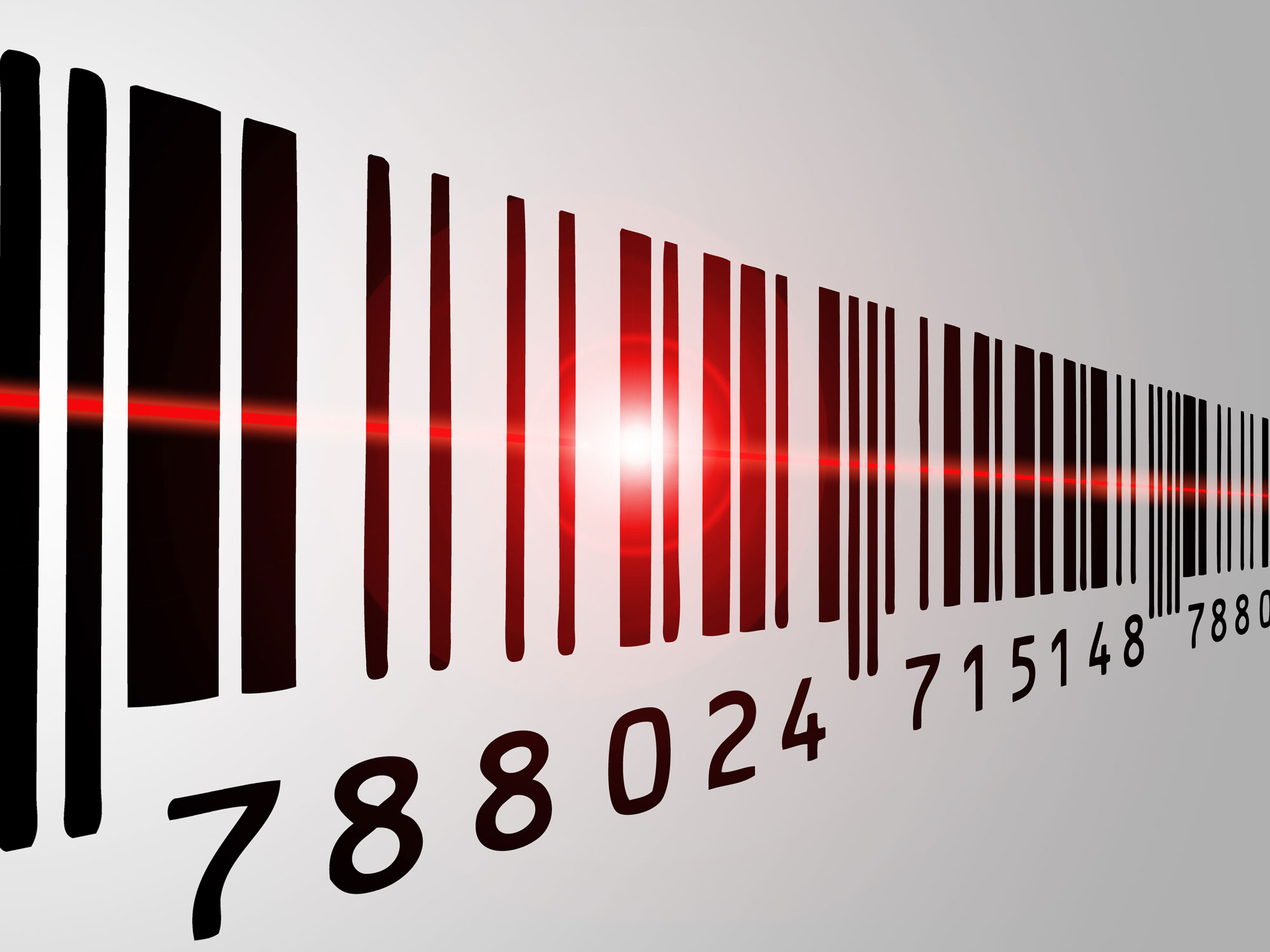
Surprisingly, this method of using vertical lines of varying thickness to represent characters that could be read and interpreted with a suitable scanner was established back in 1951. Even more surprising is that long before the compact labels we are familiar with today, the railways adopted this time-saving technology. In this case, the markings appeared on large metal plates attached to each side of a rail carriage, allowing scanners along the tracks to report their movements. Only in 1974 did a supermarket chain in Ohio become the first to install a retail barcode system. A year earlier, the nation’s National Association of Food Chains successfully completed the task of developing the uniform barcoding standard we know as the Universal Product Code (UPC).
However, the underlying concept is nearly 200 years old. It dates from the 1840s, when Samuel Morse developed the system of dots and dashes, enabling the transmission of telegraph messages by generating short or long electrical impulses when depressing a key. In 1949, a graduate student, named Woodland, and a fellow alumnus extended the dots and dashes vertically to create thick and thin lines, providing the basis for a working retail barcode system.
Innovation in Technology
Their earliest effort consisted of thick and thin concentric circles rather like a target that could be scanned from any direction. Leading electronic manufacturers of the time, like IBM, RCSA and Philco, helped develop the microchips in 1958 and the lasers in 1960 that were essential for constructing the world’s first working code scanner. However, the bullseye format was later abandoned when George Lauer of IBM demonstrated that vertical thick and thin lines were more reliable. As a proof-of-concept, IBM attached a coded label to a baseball. When thrown over a laser, it successfully read the lines, changing the retail barcode system forever.
Barcoding technology offers many benefits to retailers and their customers. For example, supermarket staff can quickly scan incoming deliveries to ensure they match the corresponding purchase orders and speed up stocktakes by accessing coded information rather than reading labels. The automatic sales recording feature can help reduce inventory levels or automatically trigger a purchase order when stock items reach a preset volume, eliminating those counterproductive “out of stock” notices. Also, when restocking shelves, when comparing the codes on the product and shelf labels, a retail barcode system can ensure each product is located correctly.
Read more about Reasons to Invest in a Retail Barcode System for Your Business here.
Smartphones and QR Codes
The most obvious benefit to customers is the speedier checkout process. However, the low-cost system also helps retailers keep prices down and ensures customers are not frustrated by annoying stock shortages. The potential scope of coded labels grew with the advent of the smartphone. Eventually, anyone with these digital devices could download a free app enabling them to scan these vertical thin lines for information. However, the UPC system was limited to twelve digits. In 1994, the need to store more data in labels drove a Japanese engineer to develop an upgraded retail barcode system. Masahiro Hara took his inspiration from the black and white squares and spaces in the game of Go to develop the two-dimensional QR (quick read) system with the vastly-extended capacity to hold up to 7 000 digits or 4 000 characters.
The additional storage capacity of a QR code enables retailers to provide additional information for smartphone users to access, such as an item’s country of origin and whether it was sourced responsibly. On comparative shopping sites, this updated retail barcode system allows one to compare prices between stores, encouraging retailers to be more competitive and enabling customers to shop more economically.
Coded labels are just as valuable to small outlets as to giant supermarket chains. Teraoka offers a range of viable options for all. We will visit your store to perform a professional installation integrated with your existing information system and ensure that your staff members are fully conversant with its operation. Please don’t hesitate to contact us for more details about our retail barcode systems.